
Personal Portfolio Website
Webflow Portfolio Evolved into a Self-Hosted CMS Platform
Project Information
- Client
- Personal Project
- Industry
- Web Design & Development
- Country
- North Macedonia
- Business Type
- Personal Portfolio
- Platform
- Webflow / Self-Hosted
- CMS
- Pages CMS
- Duration
- Ongoing
- Website
- https://igormihajlovski.com/
Project Overview
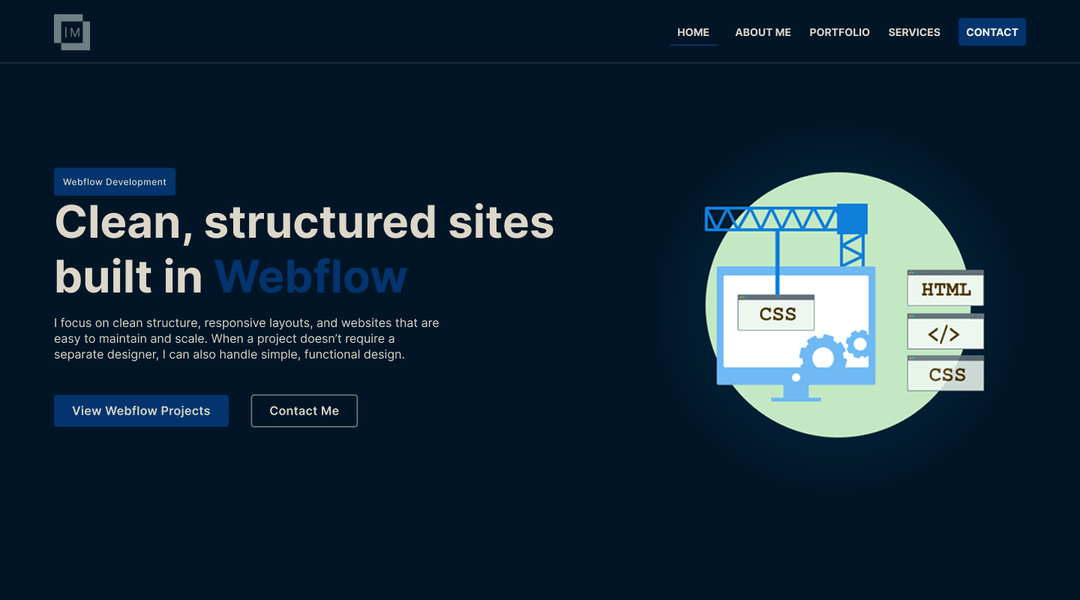
My personal portfolio started as a website designed in Figma and developed in Webflow to showcase my work, services, and experience as a Webflow developer.
As the portfolio evolved, I wanted greater control over the codebase, hosting, content management, and future development while preserving the existing design and responsive experience. The Webflow site was therefore exported and migrated to Hostinger, where it became the foundation for a progressively more customized development setup.
The website was later extended with Eleventy as a static site generator, reusable Nunjucks templates, Markdown-based project content, and Pages CMS for managing case studies without manually editing HTML. Git and GitHub were introduced for version control, while GitHub Actions now automatically builds the Eleventy site and deploys the production files to Hostinger after content or code changes are committed.
The result is an evolving, self-hosted portfolio platform that combines the visual foundation created in Figma and Webflow with a lightweight CMS, structured content, version control, and an automated deployment workflow.
The Challenge
The main challenge was to move an existing Webflow portfolio toward a more flexible and independently managed setup without rebuilding the website from scratch or compromising its established design, responsive behavior, and interactions.
The original website depended on Webflow for hosting and content structure. After exporting the site, the existing HTML, CSS, JavaScript, animations, contact form, and responsive behavior had to continue working correctly in a self-hosted environment. At the same time, the portfolio needed a practical way to add and maintain case studies without manually creating and updating HTML pages for every new project.
Another challenge was creating a publishing workflow that remained simple to use. Content changes made through the CMS needed to be stored in GitHub, converted into production-ready pages by Eleventy, and deployed automatically to Hostinger without requiring a manual build and file upload after every update.
The solution therefore had to preserve the original frontend while gradually introducing structured content, reusable templates, version control, CMS-based editing, secure form handling, and reliable automated deployment — without introducing an unnecessary backend or paid CMS dependency.
Project Goals
- Preserve the original Webflow design, responsive behavior, and user experience after migration.
- Move the portfolio to a self-hosted environment with greater control over hosting, code, and future development.
- Create a structured and maintainable system for publishing portfolio projects and case studies.
- Introduce a lightweight CMS that allows content to be managed without manually editing HTML files.
- Use reusable templates and structured content to keep all case study pages visually and technically consistent.
- Establish Git-based version control and an automated build and deployment workflow.
- Keep the architecture lightweight and cost-efficient without introducing an unnecessary backend or paid CMS dependency.
My Role
Roles
- UI/UX Designer
- Webflow Developer
- Front-End Developer
- CMS Developer
- Deployment & Automation
Responsibilities
- Designed the original portfolio interface and user experience in Figma.
- Developed the original responsive website in Webflow.
- Managed the Webflow export and migration to a self-hosted Hostinger environment.
- Preserved and extended the existing HTML, CSS, JavaScript, animations, and responsive behavior.
- Implemented and maintained the PHP contact form with Cloudflare Turnstile protection.
- Designed the Eleventy and Nunjucks architecture for reusable case study pages.
- Implemented Markdown-based project content and Pages CMS for content management.
- Configured Git and GitHub for source control and content versioning.
- Built the GitHub Actions workflow for automatic Eleventy builds and FTP deployment to Hostinger.
- Maintain and continuously extend the portfolio with new projects, case studies, and functionality.
My Approach
I approached the project as a gradual evolution rather than a complete rebuild. The existing Webflow portfolio already had an established visual identity, responsive structure, and working interactions, so the priority was to preserve that foundation while progressively gaining more control over the website and its development workflow.
The first step was to export the Webflow website and establish a clean local development structure. Instead of replacing the existing frontend, I retained the generated HTML, CSS, JavaScript, assets, and interactions, then adapted and extended them where necessary for independent hosting.
The next stage focused on making the portfolio easier to maintain and expand. Eleventy was introduced as a lightweight static site generator, with reusable Nunjucks templates and Markdown-based content separating project information from presentation. Pages CMS was then added as an editing layer, allowing case studies to be created and updated through a visual interface while keeping the content stored directly in the GitHub repository.
Finally, I automated the publishing workflow. Changes committed to the main GitHub branch trigger GitHub Actions, which installs the project dependencies, builds the Eleventy site, and deploys the generated production files to Hostinger through a dedicated FTP account restricted to the portfolio’s public directory.
This incremental approach allowed the portfolio to evolve from a hosted Webflow website into an independently managed platform without sacrificing the original design or introducing unnecessary infrastructure.
Design Process
The design process started in Figma, where I created the visual direction, page structure, typography, spacing, color system, and overall user experience for the portfolio. The goal was to create a clean and modern presentation that keeps the focus on my work while maintaining a distinctive personal identity.
The interface was designed around clear content hierarchy, strong project presentation, and straightforward navigation between services, portfolio work, and contact information. Reusable visual patterns were established to maintain consistency across sections and screen sizes.
After the design direction was established, I recreated the interface in Webflow and refined it directly in the browser. Responsive layouts were developed and tested across desktop, tablet, and mobile breakpoints, with particular attention to typography, spacing, content flow, and interactive elements.
Motion and interaction were used selectively to make the experience more engaging without distracting from the content. The resulting Webflow implementation became the visual foundation that was preserved throughout the later migration and technical evolution of the website.
Development Process
Development began with the original Webflow implementation, where the approved Figma design was translated into a responsive website using Webflow’s layout system together with custom HTML, CSS, and JavaScript where additional control was required.
As the project evolved, the Webflow website was exported and moved into a local development environment. The existing frontend structure, styles, JavaScript, images, animations, and other assets were preserved while the project was reorganized for independent development and deployment. The website was then migrated to Hostinger, removing the dependency on Webflow hosting while retaining the established frontend experience.
The self-hosted version was further extended with custom functionality. The contact form uses a PHP endpoint for server-side processing and Cloudflare Turnstile for bot protection, while existing interactive components and responsive behavior were maintained and refined where necessary.
The next major development stage introduced Eleventy as the static site generator for portfolio case studies. Project content was separated from presentation and stored as structured Markdown, while reusable Nunjucks templates generate consistent case study pages. Pages CMS was connected to the GitHub repository to provide a visual interface for creating and editing project content without manually modifying Markdown or HTML files.
Git and GitHub provide version control for both the website code and CMS-managed content. The publishing process was then automated with GitHub Actions: every relevant change pushed to the main branch triggers dependency installation and an Eleventy production build, after which the generated _dist files are deployed automatically to the portfolio’s public_html directory on Hostinger through a dedicated FTP account.
This development workflow allows future case studies and website improvements to move from content or code changes to the live production website through a consistent, version-controlled, and largely automated process.
Tech Stack
Development
- HTML5
- CSS3
- JavaScript
- PHP
- Eleventy (11ty)
- Nunjucks
- Markdown
CMS
- Pages CMS
Libraries
- jQuery
- GSAP
- WebFont Loader
Integrations
- Cloudflare Turnstile
- GitHub Actions
- FTP Deployment
Tools
- Figma
- Webflow
- Visual Studio Code
- Git
- GitHub
- Hostinger
- Google Search Console
- Google Analytics
- Microsoft Clarity
Third-Party Integrations
Cloudflare Turnstile
Bot protection and spam prevention for the portfolio contact form.
Visit websiteGitHub
Source control and repository hosting for the website code and CMS-managed content.
Visit websiteGitHub Actions
Automated production builds and deployment after changes are pushed to the main branch.
Visit websiteHostinger
Production hosting, domain management, PHP processing, and FTP deployment destination.
Visit websiteGoogle Search Console
Search performance monitoring, indexing visibility, and SEO diagnostics.
Visit websiteMicrosoft Clarity
User behavior analytics through session recordings and heatmaps to identify usability issues and improve the website experience.
Visit websiteKey Features
- Responsive Webflow-based frontend preserved and adapted for independent hosting.
- Self-hosted production website with full control over the codebase and hosting environment.
- Eleventy-powered static generation for portfolio projects and case studies.
- Reusable Nunjucks templates for consistent case study layouts.
- Markdown-based structured content separated from presentation and page templates.
- Pages CMS interface for creating and editing case studies without manually modifying code.
- Git and GitHub version control for both website code and CMS-managed content.
- Automated GitHub Actions workflow that builds and deploys production changes to Hostinger.
- PHP-powered contact form protected against spam and bots with Cloudflare Turnstile.
- Microsoft Clarity integration for heatmaps, session recordings, and user behavior analysis.
- SEO and analytics setup for monitoring search visibility, traffic, and website performance.
- Expandable case study system designed for continuously adding new portfolio projects.
Project Deliverables
- Custom-designed responsive portfolio website
- Production-ready self-hosted website on Hostinger
- Eleventy static site generation architecture
- Reusable Nunjucks case study template system
- Markdown-based structured project content
- Pages CMS content management interface
- GitHub repository and version-controlled development workflow
- Automated GitHub Actions build and deployment pipeline
- Secure PHP contact form with Cloudflare Turnstile protection
- Analytics and user behavior tracking integration
- SEO-ready project and case study structure
- Scalable portfolio system for publishing future projects
Results
The project evolved from a Webflow-hosted portfolio into an independently managed, self-hosted platform while preserving the original visual design, responsive behavior, and frontend experience.
Moving the website to Hostinger provided greater control over the production environment and removed the portfolio’s dependency on Webflow hosting. The existing frontend could continue to be developed independently while retaining the design foundation originally created in Figma and Webflow.
The introduction of Eleventy, reusable Nunjucks templates, and structured Markdown content transformed the way portfolio projects are managed. New case studies can now be created through Pages CMS instead of manually building individual HTML pages, while all projects follow the same reusable structure and presentation.
GitHub now acts as the central source of truth for both code and CMS-managed content. With GitHub Actions and automated deployment in place, changes pushed to the main branch are built and published to Hostinger automatically, significantly simplifying the publishing workflow and reducing repetitive manual deployment work.
The portfolio also retains a secure server-side contact workflow with Cloudflare Turnstile protection and includes analytics and user-behavior monitoring to support future improvements.
Most importantly, the website is no longer just a finished portfolio page. It has become a maintainable and extensible platform that can continue evolving as new projects, case studies, services, and functionality are added.
Lessons Learned
This project reinforced the value of evolving an existing website incrementally instead of rebuilding it simply because the underlying architecture needs to change. The original Webflow frontend provided a strong visual foundation, and preserving it allowed the technical architecture to evolve without unnecessarily recreating work that was already successful.
Migrating away from Webflow hosting also demonstrated the importance of separating design, content, and deployment concerns. Once the website was self-hosted, the frontend could remain largely intact while Eleventy, Nunjucks, and Markdown were introduced specifically where they provided value — reusable templates and structured case study content.
Building the CMS workflow highlighted another important lesson: a content management system does not necessarily require a traditional database or backend. For a portfolio with relatively structured and infrequently changing content, Markdown stored in GitHub combined with Pages CMS provides a lightweight solution with built-in version history and full ownership of the content.
Automating deployment was equally important. Manual uploads are manageable at the beginning, but they quickly become inefficient once content is updated through a CMS. Connecting Pages CMS, GitHub, GitHub Actions, Eleventy, and Hostinger created a much cleaner publishing workflow and reduced the number of manual steps required to move a change into production.
The project also reinforced the importance of choosing technology according to the actual problem rather than adding complexity for its own sake. The current architecture remains intentionally lightweight while still providing content management, reusable templates, version control, automated deployment, security, analytics, and room for future expansion.
Because the portfolio remains an ongoing project, the architecture can continue evolving as new requirements appear without requiring another complete rebuild.